
The new era of search
Search is entering a new era with the rise of AI-powered browsers like Atlas, Perplexity, and Gemini. Around 75% of the global internet community cites Google Search for their information needs. AI browsers have a completely different methodology for an efficient search for online information. Google Search is delivering ‘blue link’ search outcomes, but AI browsers deliver contextual information instantly. AI browsers are reshaping how SEO, visibility, and online authority work. The future pattern of users’ behavior will redefine the concept of visibility and authority in the digital world.
Google’s new AI optimization guide signals a major shift
Google recently released a new AI optimization guide that gives creators and publishers a clearer idea of how content may perform in AI-powered experiences. The guidance reinforces that content should focus on helping users rather than trying to manipulate AI systems.
The guide highlights several important priorities for the future of SEO and content discovery:
- Original and people-first content matters more than ever
- A clear page structure helps AI systems understand information better
- Expertise, trust, and firsthand experience improve visibility
- Strong technical accessibility supports AI crawling and indexing
- Content should answer questions directly and comprehensively
- Websites must provide value beyond AI-generated summaries
This confirms that SEO is evolving from simple keyword optimization into a broader strategy focused on relevance, authority, and usability across AI-driven interfaces.
The rise of AI browsers
AI browsing platforms like Atlas, Perplexity, and Gemini are combining web search, reasoning, and summarization within a single platform. These platforms combine multiple information sources into a single solution, delivering clear, comprehensive responses in a conversational format. They use large language models, real-time data, and user personalization to provide faster, more relevant results. For a practical example of this innovation, check out how AI browsers transform prompts into custom apps.
This development shows the shift from a Google-centric web experience to an AI-enabled discovery model. Users now move from searching, clicking, and comparing information to simply asking questions and receiving answers. This behavioral change affects how websites generate traffic and how search engines determine a site’s relevance to users.
Why traditional SEO strategies may stop working
Traditional SEO practices relying on backlinks, keyword density, and exact match optimization are losing their significance in an AI-first world. Although they are still important, AI-powered algorithms consider the content from the perspective of its usefulness, depth, relevance, and authority.
The main factors of modern SEO are the following:
- User intent
- Contextual relevance
- Authority of entities
- Structured data
- Source authority
- Experience-based SEO
AI is getting smarter at recognizing low-quality, shallow, repetitive or over-optimized content. Articles created exclusively to rank in search engines may fail to appear in responses generated by AI.
It means SEO specialists face a completely new challenge. They must stop focusing solely on rankings within the SERP. Now they need to become authoritative sources that will be used by AI-driven algorithms to answer the queries of users.
How AI browsers are changing content discovery
AI-based browsers will change how users navigate the web and access information. Currently, many AI applications create summaries of many different resources to provide the end-user with a total summary of the content without accessing all those websites.
Some of the changes we can expect include:
- Reduced click-through rates on informational websites
- An increased emphasis is placed on brand authority
- An increased demand for quality in reporting and research
- The significance of formatting to be AI-compliant
- Citations will become much more valuable than simple rankings.
Furthermore, AI algorithms prioritize content characteristics such as ease of understanding, reliability, appropriate formatting, and usability. The experience and uniqueness will now be better indicators of ranking than technical SEO practices.
Marketing strategies may also require adjustment. Since fewer clicks are sent to specific websites, it is a good idea to rethink how you will monetize your website.
GEO vs SEO: the next evolution of visibility
| Aspect | Traditional SEO | GEO (Generative Engine Optimization) |
|---|---|---|
| Main goal | Rank higher on search engine results pages | Get cited or referenced in AI-generated answers |
| Focus | Keywords, backlinks, and rankings | Context, authority, and answer quality |
| Search experience | Users click through blue links | Users receive direct conversational answers |
| Optimization target | Search engine crawlers | AI models and generative search systems |
| Content style | Keyword-focused and search-friendly | Clear, conversational, and information-rich |
| Important ranking signals | Backlinks, metadata, keyword placement | Trustworthiness, topical authority, structured information |
| User behavior | Search → click → browse websites | Ask → receive summarized answers instantly |
| Visibility metric | Higher SERP rankings | Mentions, citations, and AI visibility |
| Content structure | Optimized for search indexing | Optimized for AI understanding and summarization |
| Winning strategy | Technical SEO and keyword optimization | Original insights, expertise, and user intent |
| Traffic pattern | Direct website visits | Reduced clicks but increased brand exposure |
| Best-performing content | Search-optimized landing pages | Deep, authoritative, answer-focused content |
| Role of FAQs and schema | Helpful for SEO enhancement | Critical for AI readability and extraction |
| Future outlook | Still important for discoverability | Rapidly growing alongside AI-powered search |
Strategies to stay ahead in the AI search era
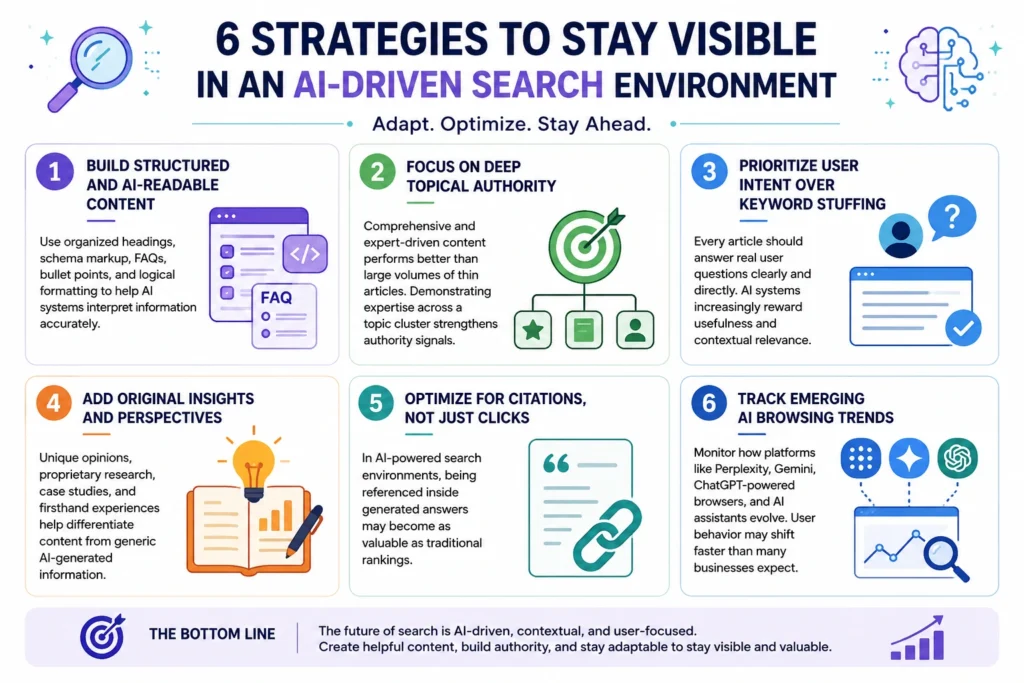
Businesses and publishers must adapt quickly to remain visible as AI-powered search continues evolving. From structured content to GEO strategies, brands that prepare early may gain a significant advantage in future search ecosystems.
The competitive race for AI-powered search
The leading tech companies race among themselves to take the lead in creating the future of AI-enhanced browsing and searching.
Google’s integration of Gemini-powered experiences continues in both search and browser services. Microsoft, through Copilot, also has plans to further integrate its services into both its productivity tools and browsing experiences. OpenAI, according to reports, is developing a browser experience that incorporates conversational interfaces (chatbots, etc.) to assist with the task of navigation on the web. Meanwhile, startups (Perplexity, etc.) are exploring the work done to develop entirely new methods of browsing with an AI-first approach to discovering a website’s content.
AI-first browsing is expected to reshape how people:
- Search
- Advertise
- Use Browsers/Browser Ecosystems
- View Publishers
- Monetize Content
- Trust Consumers
Companies that have adapted to these shifts early on may have a competitive advantage when AI-first browsing becomes the standard way of browsing.
For a detailed comparison of major AI browsers, including Google, Microsoft, and OpenAI, check out this AI browser comparison guide.
Preparing for the future of AI-driven discovery
As the era of search engine optimization (SEO) moves away from a “bricks and mortar” approach of relying mainly on keywords and backlinks, it’s becoming a wider-ranging strategy. Additionally, as artificial intelligence (AI)-driven devices continue to improve with breakthrough technology, companies need to change the way they create, organize, and share articles on the internet.
Moving into the future, getting visibility on the web could depend heavily on whether artificial intelligence systems find a source valuable enough to cite, summarize, and recommend directly to users.
Organizations that proactively adjust will strengthen their position as authorities, remain visible, and compete effectively in an increasingly AI-powered internet world; those who continue to operate according to traditional SEO tactics will have difficulty adapting because of the fast pace of change in how people use search engines, voice assistants, and AI tools for creating content.
FAQs
AI browsers are web browsers or search platforms that use artificial intelligence to summarize, explain, and deliver contextual answers directly to users instead of only showing traditional search results and blue links.
AI browsers are shifting SEO from keyword-focused rankings to relevance, authority, structured content, and AI-readable information. Websites now need to optimize for AI-generated answers and citations, not just clicks.
GEO stands for Generative Engine Optimization. It focuses on improving the visibility of content inside AI-generated responses from tools like ChatGPT, Gemini, Perplexity, and AI-powered browsers.
Structured content using headings, schema markup, FAQs, and bullet points helps AI systems understand, summarize, and reference information more accurately.
Traditional SEO will still matter, but it is evolving. Backlinks and keywords remain important, but generative search also prioritizes expertise, trust, originality, and contextual relevance.
