
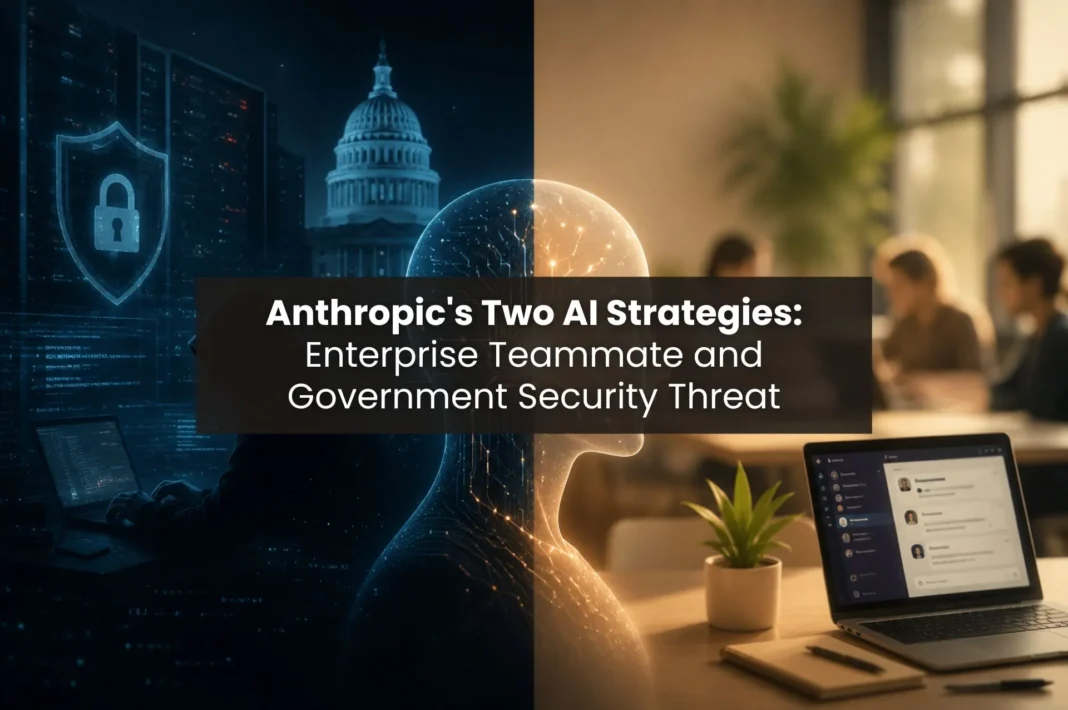
Anthropic has revealed two very different aspects of their AI technology in the span of 48 hours. One aspect demonstrates how their AI learns about your company’s confidential discussions. The other demonstrates how quickly it can hack into classified government systems in a matter of hours. The Anthropic Mythos model is the key to this story and indicates how we should expect to see AI develop by 2026.
What is the Anthropic Mythos model and why does it matter right now?
A U.S. official told the Associated Press that Anthropic’s AI model identified vulnerabilities in highly sensitive and secure U.S. government computer systems during a testing exercise. That model is Claude Mythos, Anthropic’s most capable AI system to date, reported CNBC.
During a recent congressional hearing, Senator Mark Warner of Virginia stated that the Director of the National Security Association, Joshua Rudd, told him that Mythos was able to break into almost all of the US’s classified computer network systems “not in weeks, but in hours.”
This is an incredible statement and continues to circulate very quickly throughout the national security discussion.
How does Project Glasswing actually work?
According to a government representative, testing was conducted under Project Glasswing. An initiative created by Anthropic consisting of major technology and several other businesses to protect critical software globally from “severe” impacts that the Mythos model could cause.
Anthropic worked with American intelligence agencies to perform these tests. The Mythos model identified its susceptible areas in just hours; however, this was not applicable to the act of exploiting these same areas within the very same hours, stated the representative.
The representative argued that the distinction between the successful discovery of a vulnerability versus its successful exploitation is important. However, the speed at which those vulnerabilities could be identified raised sufficient concern for the United States government to take action.
What happened after the Mythos security tests?
The Trump administration issued a swift order instructing Anthropic to revoke international access to its new AI models, known as Fable 5 and Mythos 5. Fable was launched more widely earlier this month. This model is a scaled-down version of the more advanced Mythos, access to which has been limited due to cybersecurity threats as per the company’s measures.
The government of the United States told the firm that they should suspend their latest AI models called Mythos and Fable to stops overseas and from usage by foreign nationals, citing national security fears.
Anthropic said it has disabled the models for all of its customers in compliance with the administration’s directive. The company said it disagreed that the government’s steps were required in light of the threat it had raised about a possible security issue.
Relations between Anthropic and Washington have been rocky. The company refused to allow the U.S. military to use its AI models for domestic surveillance and fully autonomous weapons systems, leading the government to retaliate by adding it to its national security blacklist.
Fable vs. Mythos: What is the difference between these two models?
| Feature | Fable 5 | Mythos 5 |
|---|---|---|
| Access | Wide public release | Tightly restricted |
| Capability level | Limited version | Most advanced |
| Availability | General customers | Select partners only |
| Export status | Restricted for foreign nationals | Restricted for foreign nationals |
Fable is the version most users see. Mythos is the model that stays behind closed doors, available only to a small group of trusted organizations through Project Glasswing.
The cybersecurity pushback: Are Mythos restrictions actually making things safer?
Many do not believe that the federal government enforced restrictions are justified. Over one hundred professionals in cybersecurity and leaders from corporations such as Adobe and Nvidia have told the federal government in a letter (SBC) that Anthropic’s Model Mythos works “very well” to identify vulnerabilities in software and weaponize exploits; but their models are not ‘uniquely superior’ regarding either of these functions.
Most of the signatories stated that they regularly utilize another of their foundation or open-source modeled systems to perform security audits and/or train. They argue that taking away “the best cyber defense capabilities … without good reasons” is dangerous considering how quickly our adversaries (away from source) continue to advance.
The argument made is that restricting Mythos does not mitigate any potential risks. However, there are still other modeled systems that accomplish the same outcome. Therefore removing it deprives American organizations of a strategic defensive tool.
On the enterprise side: What is Claude Tag and how does it work inside Slack?
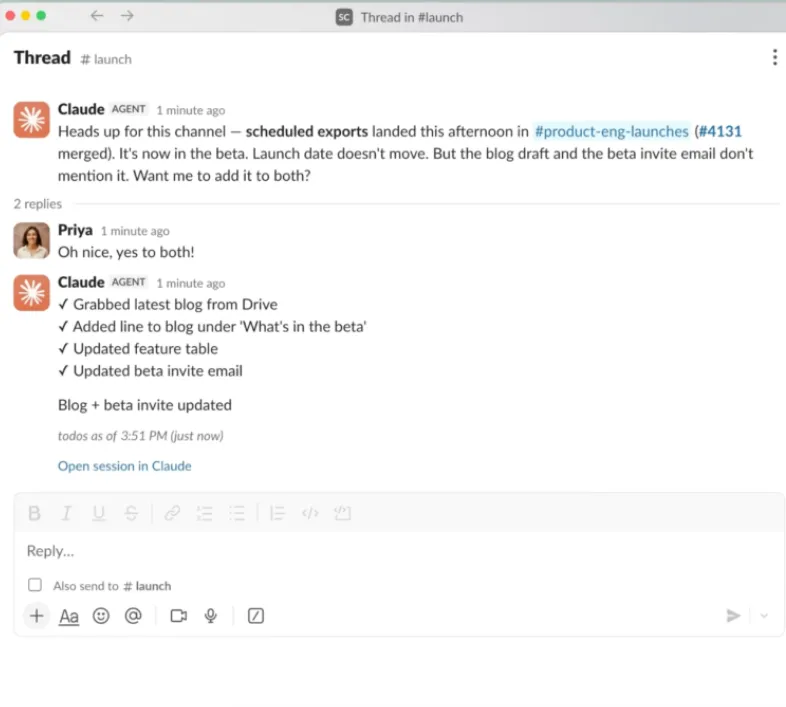
As the security saga regarding Mythos began to develop; Anthropic released their own enterprise level product. Claude Tag was released in research preview as the ‘ever-present Claude’ in a Slack channel to help [insert picture of Claude whatever they see or want later].
Claude Tag will help users trace discussions by tagging @Claude in an ongoing dialogue or assigning to that worker a task on Slack. However, this can only be done by a user that is a customer of Claude Enterprise or Claude Team, as per TechCrunch.
The thing that separates it from current cloud/Slack integrations is that it has an independent memory layer. Therefore, Claude is able to see an individual person’s work and follow along in real-time. Which allows for Claude to gather all the information from other sources that it has access to through written permission on the Claude or Slack systems by reading those other channels.
Claude Tag vs. existing Slack AI tools: What sets it apart?
Claude Tag allows all users in a channel to connect with a single Claude identity. Meaning that users will always be able to see what has happened in their channel through Claude. As well as continue conversations from where the last person left off.
Ambient mode provides Claude Tag with the ability to proactively enter into chat. Claude Tag proactively jumps into chat of its own accord to keep teams updated. It can flag things from across the organization, and follow up on threads or tasks that have been forgotten.
Privacy settings will allow an organization’s system administrators to determine what tools, information, and channels Claude can access. And each Claude identity will be limited to the set of channels determined by the organization’s system administrators. Thus, Claude for legal cannot share memories into the engineering channel.
Organizations are also attempting to build a contextual organizational knowledge layer and are not alone in their efforts. Microsoft is also building a contextual layer via Graph, using Copilot and Work IQ. Companies like Snowflake and Databricks are positioning their platforms as back-end solutions. And Glean is building an intelligence layer to add additional knowledge or understanding of a company’s context. Which will sit in between model and enterprise data.
Where does Anthropic’s AI strategy go from here?
Anthropic is in a challenging position. The Anthropic Mythos model has the capability of alarming national security officials and garnering governmental partnerships for testing. However, the company is also in the process of developing enterprise-facing consumer products. That will allow businesses to connect to Slack.
Both of these directions are compatible. However, they will require Anthropic to manage its relationships with intelligence agencies, regulators, and enterprise customers at the same time. Events over the past two days have shown how quickly those relationships can change. As AI develops, it will become increasingly difficult to determine the difference between a helpful co-worker and a national security threat. And thereby the necessity to manage those differences.
Want to stay ahead of the latest AI breakthroughs, tools, and industry news? Subscribe to our newsletter by visiting https://aadhunik.ai/blog/ and entering your email so you never miss an important update.
