
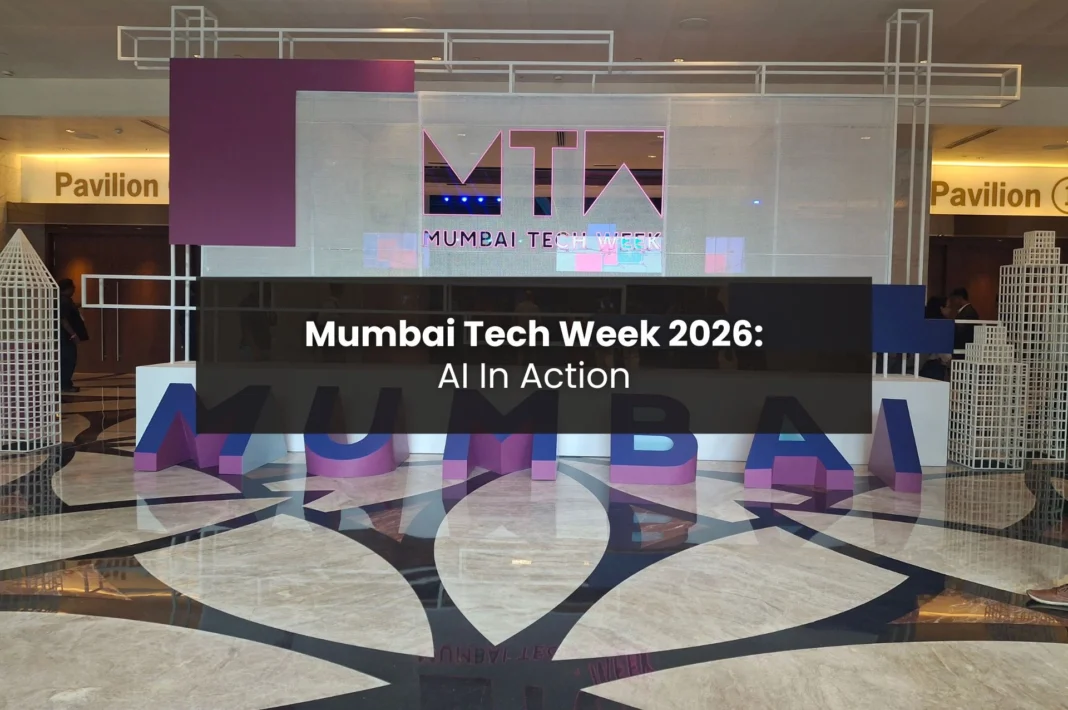
I went to Mumbai Tech Week 2026 so you didn’t have to
Representing Aadhunik, I attended Mumbai Tech Week 2026 expecting another technology conference filled with discussions about the future of artificial intelligence. Instead, I walked into an event where founders, developers, students, investors, corporate leaders, and policymakers were actively demonstrating what AI can already do today.
Positioned as one of India’s largest AI and technology gatherings, Mumbai Tech Week 2026 focused less on theoretical conversations and more on real-world implementation. That focus became clear almost immediately through one statement repeated throughout the event:
“No presentations, no theories, just the technology doing all the talks.”
The phrase perfectly captured the atmosphere. Rather than watching endless slide decks, I spent most of my time exploring startup booths, live demonstrations, product launches, and conversations about practical AI adoption.
Was Mumbai Tech Week 2026 India’s biggest AI event?
While many tech conventions take place throughout the year in India, the significance of this conference was its breadth of participation and focus on AI.
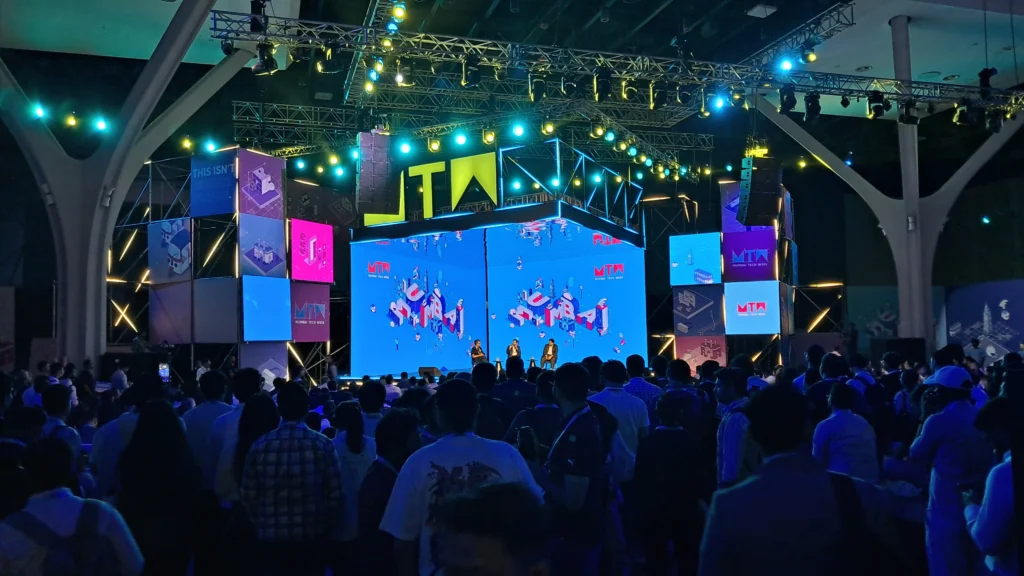
Founders of startups, venture capital firms, corporate executives, government officials, and student/developer communities filled the hall for this gathering; startups demoed their product offerings to various audiences, and investors met with founders to form strategies to build their businesses, while enterprises evaluated the potential of implementing artificial intelligence.
An integral part of the conference was MOUs signed for AI project development, and many speakers on the AI front discussed how they will build AI infrastructures, utilize AI agents, implement AI solutions, grow their businesses, and other related topics during this event. Simultaneously, companies were launching products, networking with one another, pitching ideas to venture capitalists, and taking part in job fairs where aspiring professionals could meet the leading startups in the area.
Representatives from the Maharashtra State Government were in attendance and expressed their vision and ambition surrounding the AI industry of the region, while venture capitalists and startup founders discussed how the robust technology landscape in India is creating a multitude of new opportunities.
I can easily classify Mumbai Tech Week 2026 as one of the most well-attended and highly regarded AI-focused events held in India, having been there for the entire day.
The vibe check: Builders were running the show
Each event acquires its own identity.
Some conferences cater to investors. Some conferences cater to corporations.
In 2026, Mumbai Tech Week belonged to the builders.
As I navigated through the exhibit floor, I observed that there was a lot of effort being made by founders to demo their products instead of pitch ideas. Students tried out technologies, and startups had interactions with them. Investors mostly observed demos and engaged with founders themselves. Enterprise players looked into practical implementations instead of possibilities.
The theme of this year’s event, “AI in Action,” mirrored the actions taking place.
People were not discussing whether AI will disrupt industries or not. Instead, they showed that it has done so.
There was maximum energy among builders who were working towards developing solutions and implementing them.
Maharashtra wants to lead India’s AI revolution
One of the highlights of the event was the statement made by the Maharashtra Chief Minister Devendra Fadnavis regarding his vision for the AI industry in the state.
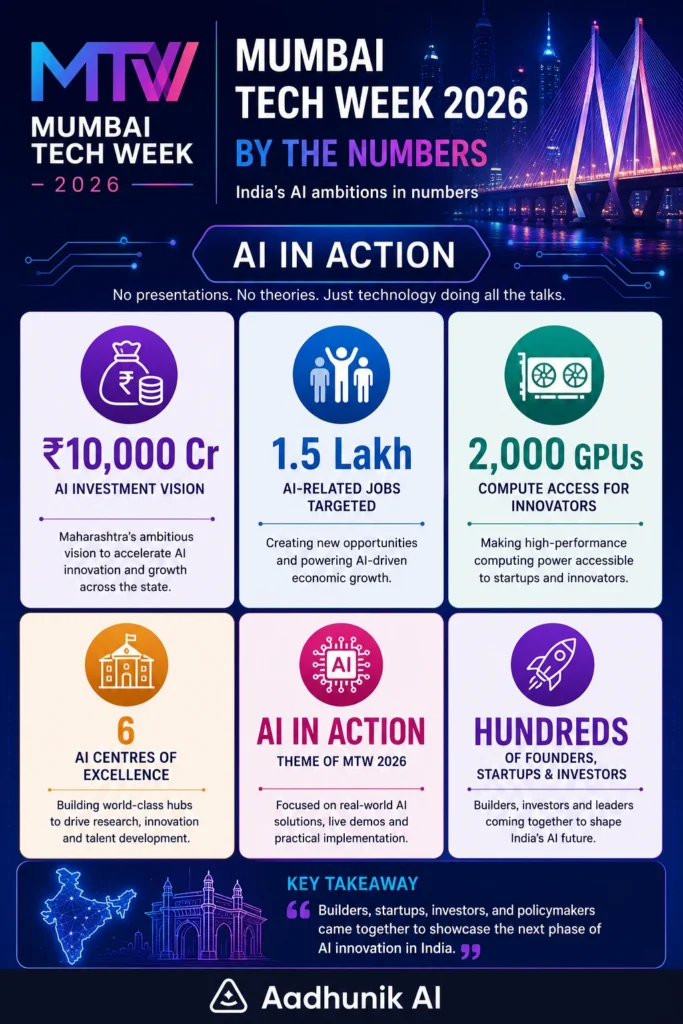
Amongst other announcements, there was a vision to invest ₹10,000 crore into AI, establish six AI Centres of Excellence and AI Innovation Regions, and aim to create 1.5 lakh jobs via AI-powered initiatives.
However, perhaps the most important announcement concerned computing infrastructure:
“We will make available 2000 GPUs to innovators so they can have direct access to computing power.”
Access to computing is still one of the major challenges faced by Indian AI startups.
AI model training and deployment require a lot of resources, which not all startups are able to access due to budget constraints. The announcement also reflects a broader trend across the AI industry, where access to high-performance computing is becoming increasingly important. As AI models grow more complex, startups are actively exploring platforms such as Compute Stacker to compare GPU cloud providers and identify the infrastructure needed to train, deploy, and scale AI applications efficiently.
The aforementioned initiative with 2,000 GPUs available as a service would help mitigate the issue significantly.
The speakers and sessions that stood out
A few sessions during the conference demonstrated India’s maturation as an AI community.
While Devendra Fadnavis discussed infrastructure, policy, and investments, TEAM leadership focused on the ambitions of their city to become a technology hub and retain talent.
Startup entrepreneurs explained how they grew their businesses using AI, whereas venture capitalists discussed opportunities in various domains like healthcare, enterprise software, and infrastructure.
One common point that could be found across several sessions was that AI was already transitioning from an experimental stage to actual implementation.
However, one more pattern kept recurring in founders’ speeches, which was that companies that managed to apply AI to their processes would create the most value.
The discussions also reflected a larger industry trend, with major technology companies accelerating their AI roadmaps. Many of the themes discussed at Mumbai Tech Week 2026 echoed the announcements unveiled at Google I/O 2026, where Google expanded Gemini’s role across Search, Android, Workspace, and AI agents.
Key insights from the main stage
- Devendra Fadnavis (Government of Maharashtra): Emphasized AI infrastructure, announcing plans around AI investment, innovation hubs, and expanded access to compute resources for startups.
- OpenAI (Pragya Misra, Thomas Jeng): Discussed how India is becoming a major market for AI innovation and highlighted opportunities for startups building AI-powered products.
- Anthropic (Irina Ghose): Focused on responsible AI development and building trustworthy AI systems for enterprise use cases.
- Meta (Arun Srinivas): Shared how AI is becoming central to digital products, business growth, and customer experiences.
- Google DeepMind (Manish Gupta): Highlighted the rapid pace of AI advancement and the growing role of AI research in solving real-world problems.
- Google Cloud (Amit Kumar): Discussed AI infrastructure, cloud adoption, and how businesses can scale AI applications effectively.
- PhonePe (Sameer Nigam): Spoke about building large-scale technology products and leveraging innovation to improve user experiences.
- MakeMyTrip (Rajesh Magow): Shared insights on how AI is transforming travel, personalization, and customer engagement.
- Swiggy (Madhusudhan Rao): Discussed AI’s role in operational efficiency, product development, and scaling digital platforms.
- Neysa (Sharad Sanghi): Emphasized the importance of AI infrastructure and cloud platforms in supporting India’s next generation of AI startups.
- Urban Company, Meesho, upGrad, Pine Labs, and Replit: Shared practical examples of AI adoption, product innovation, and building technology-led businesses at scale.
Startups were everywhere, but that wasn’t the story
Going through the exhibition floor, I met startups operating in the fields of healthcare, AI infrastructure, warehouse automation, enterprise software, finance, agriculture, and customer engagement.
These companies and organizations included Atlas University, Domywork.ai, Vorflux, Discovr AI, WebEngage, Vaidya.ai, Simplismart, Cockroach Labs, IndiaBonds, Pashu Vaani, Aurevia AI, Neysa, LoveLocal, Shaadi.com, Meta, EDT, and NPCI, providing innovative solutions for a variety of problems from both business and consumer sides.
But the startups alone weren’t the most exciting thing.
It’s the number of founders that had progressed beyond concepts and prototypes that made an impression. The majority of exhibits consisted of ready-to-go products with current implementations and success stories.
While this article focuses on the broader trends and takeaways from the event, many of the startups and technologies I explored deserve a closer look. I’ve covered some of the most notable product demos, AI platforms, and emerging innovations in our Mumbai Tech Week 2026 innovation showcase.
A lot of these startups need to be analyzed individually, but that would be covered in an innovation round-up.
The one thing that surprised me most
My expectations were discussions on AI.
However, the thing that really caught my attention was the number of firms already implementing AI products in actual settings.
In areas like health care, infrastructure, logistics, finance, agriculture, and enterprise systems software, the entrepreneurs showcased products that can be used immediately in business versus technologies that would be of any use after several years.
This appeared to mark a major turning point.
A few years back, discussions on AI involved prospects. During the 2026 Tech Week in Mumbai, all discussions revolved around implementation, execution, and impact.
And this, perhaps, marks the most evident evolution of the ecosystem.
What Mumbai Tech Week 2026 told me about India’s startup ecosystem
1. AI startups in India are moving beyond hype
- Founders are building products instead of just ideas.
- Startups are focusing on practical business problems.
- AI is being applied across healthcare, logistics, finance, agriculture, and enterprise software.
- Companies are demonstrating real deployments and customer use cases.
- Conversations have shifted from AI possibilities to AI implementation.
2. Infrastructure is becoming a strategic priority
- Access to GPUs is emerging as a major competitive advantage.
- Cloud platforms and AI infrastructure companies are gaining importance.
- AI deployment and optimization tools are becoming essential for startups.
- Government support for compute resources could accelerate innovation.
- Infrastructure is becoming as important as AI models themselves.
3. The Indian startup ecosystem is maturing
- Founders are prioritizing execution over buzzwords.
- Investors are looking for real-world business applications.
- Enterprises are actively exploring AI adoption strategies.
- More startups are focused on building sustainable businesses.
- Collaboration between startups, government, academia, and investors is increasing.
4. Builders are driving the next wave of innovation
- The strongest energy at the event came from builders.
- Product demonstrations attracted more attention than presentations.
- Founders were showcasing working solutions rather than concepts.
- Students and developers were actively engaging with emerging technologies.
- The focus was on creating impact rather than generating hype.
5. Government support is accelerating AI growth
- Maharashtra outlined an ambitious AI roadmap.
- Plans include ₹10,000 crore in AI investments.
- The state aims to create 1.5 lakh AI-related jobs.
- Six AI centres of excellence are planned.
- The 2,000 GPU initiative could help AI startups in India access critical computing power.
6. AI adoption is spreading across industries
- Healthcare platforms are improving medical workflows.
- Logistics companies are automating warehouse operations.
- Financial platforms are making investments more accessible.
- Agriculture startups are helping farmers and livestock owners.
- Enterprise software companies are streamlining business operations through AI.
7. Mumbai is positioning itself as a major AI hub
- The city is attracting founders, investors, and technology companies.
- Universities and startups are collaborating on innovation.
- AI-focused events are becoming larger and more influential.
- Local organizations are working to retain tech talent.
- Mumbai is strengthening its role within the Indian startup ecosystem.
The bigger story behind Mumbai Tech Week 2026
I attended the Mumbai Innovation Showcase and found it to be a compact yet highly impactful event. In a short span of time, it brought together a wide range of innovative startups and technologies under one roof. Overall, it was an insightful experience that highlighted how rapidly the innovation ecosystem is evolving.
While some notable announcements were certainly made during the conference, they pale in comparison to the increasing number of builders who were actually making something happen.
The common belief of those who attended the event was that AI would definitely have a significant place within India’s next wave of growth.
One particular thing that struck me during the event was the focus on execution. The builders were the ones who mattered more than any buzzwords. The demos of their products were what counted over any forecasts and predictions.
Based on my observations, the next step for the Indian AI industry will be about execution, infrastructure, and impact rather than just hype.
For a deeper look at how AI pricing shifts are reshaping global competition, read more on DeepSeek’s 75% AI price cut and its impact on OpenAI and Anthropic.
